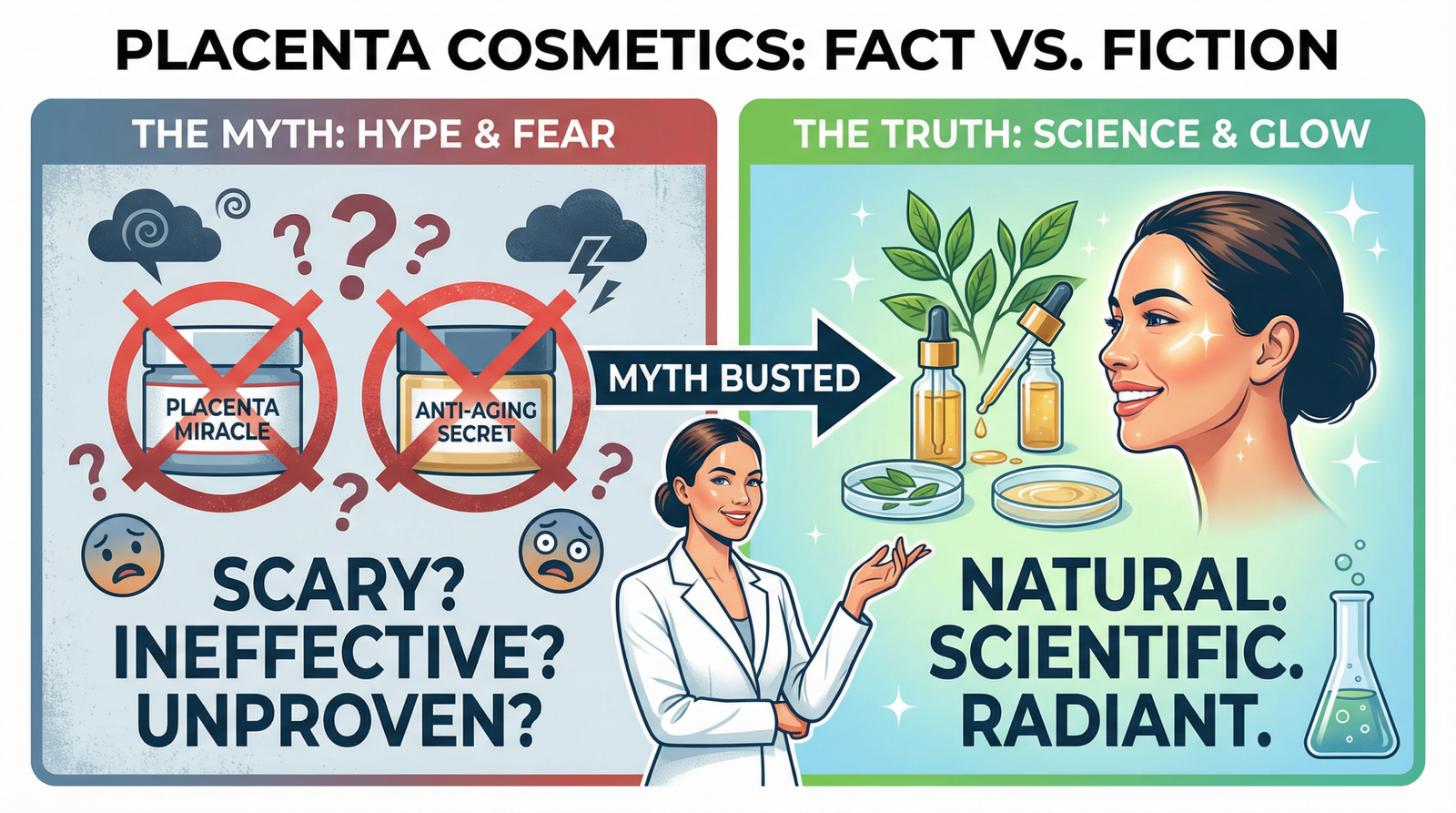
Surely you have already heard about placental cosmetics and preparations. Many myths and rumors surround this topic — from where the placenta itself comes from to the supposedly incredible composition of such products. What is true and what is fiction — we will explain below.
The placenta is an organ that forms in the bodies of all female mammals during pregnancy. Its main function is to transfer nutrients, oxygen, water, and other substances between the circulatory systems of the mother and the fetus.
Placental extracts have antibacterial and antiviral properties. The presence of amino acids, enzymes, trace elements, and unique biologically active substances in the placenta — especially regulatory proteins — allows placental preparations to activate “dormant” cells in the adult body, leading to their multiplication, renewal of cellular composition, and ultimately rejuvenation.
“Regular placental therapy allows cells to renew and divide at the same rate as in childhood and adolescence. Thanks to this, one can not only look ten years younger but also feel young.”
(Professor Kentaro Yoshida, practicing physician and author of the book “The Placenta That Serves Women.”)
The History of Placenta in Medicine — From Avicenna to the Present
Ancient Eastern civilizations were already aware of the benefits of the placenta — they used it, for example, to produce powders for various diseases. Avicenna and Hippocrates wrote about the placenta and its properties.
In the modern era, interest in the benefits of the placenta began in the 1930s thanks to Professor V. Filatov. He developed the theory of biogenic stimulators (which includes the placenta) and created preparations containing placental extract. By the 1960s, placental research had spread to nearly all scientific institutes worldwide.
Today, Japan holds the leading position in studying placental properties and producing placental preparations. Back in the 1960s, more than 10,000 studies were conducted there, and the placenta was successfully used in treating over 80 diseases. In Japan, placental therapy is even included in the insurance medical system. The country is also the producer of one of the leading preparations in placental cosmetology — Laennec.
Where Does Raw Material for Placental Products Come From? Is Its Use Ethical?
For many people, the phrase “placental cosmetics” evokes rather grim images — aborted material, embryos, parts of animals or humans — all supposedly ending up in a jar of cream.
In reality, this is far from true.
First, medicine and cosmetology use only placenta obtained from a healthy woman after a successful childbirth. The placenta forms only after the 12th week of pregnancy and therefore cannot be present in abortion material due to the late and risky stage required.
Second, the placenta itself is not used as a whole. Modern extraction technologies isolate only specific components, which are processed into purified powder or extract.
Third, after childbirth the placenta is no longer needed by either the baby or the mother. By collecting it, manufacturers actually take responsibility for its proper disposal.
Fourth, in Japan manufacturers obtain written consent from the mother for the use of her placenta, after which it undergoes thorough health screening and compliance checks with strict standards.
Is It Safe to Use Human Placenta in Cosmetics and Medicine? Does It Contain Hormones?
Placenta is collected only from healthy women after safe childbirth and the birth of a healthy baby. In Japan, this program is state-regulated and strictly controlled. Female donors are tested for HIV, tuberculosis, hepatitis, and other infectious diseases.
Early placental cosmetic products did indeed contain hormones. However, today all raw materials are fully purified from hormonal components.
Will Placental Cosmetics Be Effective Without Hormones
The placenta contains many substances that have rejuvenating and restorative effects (more about them below). Therefore, placental cosmetics can be highly effective even without hormones in their composition.
Composition and Benefits of Placenta
The placenta is often called a “treasure trove” of nutrients. It contains more than 100 components necessary for cellular function: vitamins, proteins, minerals, amino acids, lipids, hyaluronic acid, enzymes, nucleic acids, immunostimulators, growth factors, peptides, and more.
Regular use of placental preparations helps slow down aging, restore strength after physical exertion, and address skin and hair problems. But that is not all.
The use of placental cosmetics and preparations is recommended for:
- Chronic fatigue syndrome
- Potency problems
- Pigmentation spots and wrinkles
- Swelling
- Low immunity
- Liver diseases
- Skin diseases (atopic dermatitis, herpes, psoriasis, eczema, acne)
- Gynecological conditions (dysmenorrhea, infertility, ovarian dysfunction, etc.)
- Gastrointestinal diseases (gastric ulcer, stomach cancer, chronic constipation)
- Neuroses, migraines, and more
And this list is far from complete. In Japan alone, more than 80 diseases are reported to show positive results when treated with placental preparations.
Stay healthy!